
1. BIOS (Basic Input/Output System)
Function: The BIOS initializes the system hardware (CPU, memory, etc.) during startup.
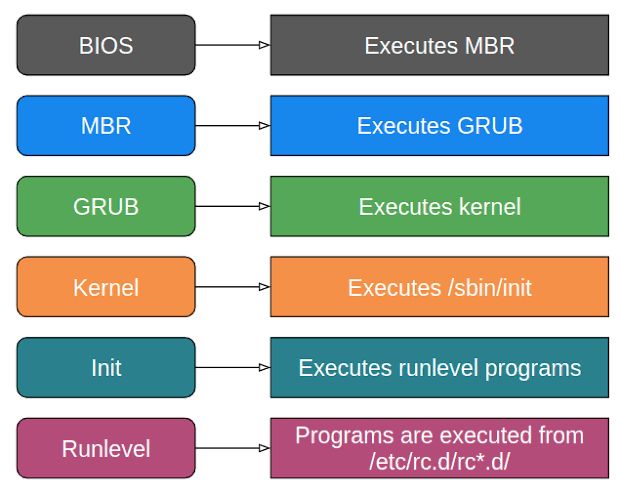
Next Step: It loads and executes the MBR (Master Boot Record) from the bootable device.
2. MBR (Master Boot Record)
Function: MBR is the first sector of the storage device (usually 512 bytes).
Next Step: It contains bootloader code, and it executes GRUB (or another bootloader).
3. GRUB (GRand Unified Bootloader)
Function: GRUB allows users to select the OS to boot (in multi-OS environments) and passes control to the OS kernel.
Next Step: It loads and executes the Linux kernel.
4. Kernel
Function: The kernel is the core of the OS. It initializes system hardware and mounts the root filesystem.
Next Step: It starts the /sbin/init process (or a modern replacement like systemd).
5. Init
Function: Init is the first process started by the kernel in user space. It sets up the environment for users.
Next Step: It executes the runlevel programs (scripts that bring the system to a specific operational state).
6. Runlevel
Function: Runlevels determine what services and processes are started.
Details: Programs are executed from /etc/rc.d/rc*.d/, where each runlevel has a corresponding directory containing startup scripts.
TAGS
Categories
Comments are closed